Practice note
MetaTrader 5 is not a platform so much as a set of seams: terminal to server, server to bridge, bridge to liquidity. Our work lives in those seams, and it is measured in milliseconds and reconciliation lines.
Northbridge is an independent engineering practice of eleven people. We do not run funds, sell signals, or manage money. We write MQL5, C++ and Python for brokers, proprietary desks and systematic traders who need software that behaves the same on a quiet Tuesday and at 17:00 New York on a payrolls Friday.
Every engagement begins with a document we call the latency budget: a written statement of what the system must do, how fast, under which failure conditions, and how we will prove it. If a requirement cannot be tested, we rewrite it until it can be.
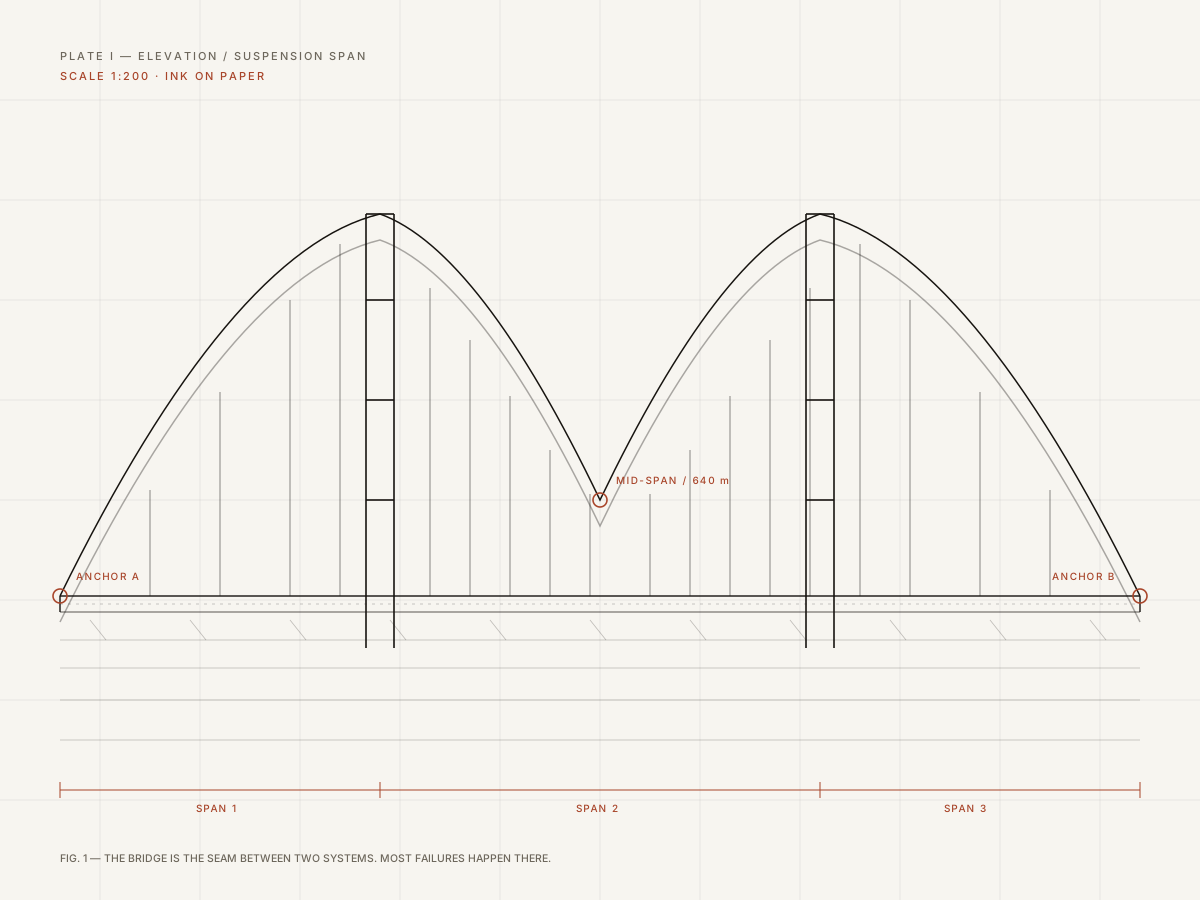
Fig. 1 Elevation study — the bridge is the seam between two systems.
312Projects since 2016
4.8 msMedian order RTT
99.992%Bridge uptime, 12 mo
11Engineers, no sales
01
The work
Four disciplines
A · Advisory & specification
Before the code
Most MT5 projects fail in the specification, not the implementation. We write the acceptance criteria, the failure taxonomy and the latency budget, then hand you a document you can hold any vendor to.
Execution model review
Latency & slippage budget
Vendor & LP selection support
B · MQL5 development
Expert Advisors & tools
Production MQL5: order-state machines, prop-firm rule sets, panel UI drawn on canvas. Every release passes a replay-and-diff regression suite before it reaches a live account.
Multi-symbol, multi-timeframe logic
Footprint & order-flow tooling
Source and escrow as standard
C · Execution infrastructure
Bridges & routing
FIX connectivity from MT5 into LMAX, PrimeXM and oneZero, with pre-trade risk in the path, smart routing on partial fills, and an order log you can replay byte for byte.
A/B book split by symbol group
Active/active gateways, LD4 + NY4
Deterministic reconciliation
D · Risk & surveillance
The gate before the gate
Pre-trade exposure, margin and news-window limits; post-trade flags for latency arbitrage and manipulation patterns. Everything logged immutably, because compliance will ask.
Exposure aggregation by correlated group
Audit export in regulator-ready form
Runbooks for the 03:00 failure
Four weeks from specification to a system you can measure.
Fixed-scope discovery, weekly builds, an adversarial test pass, then handover with source, build scripts and runbooks.
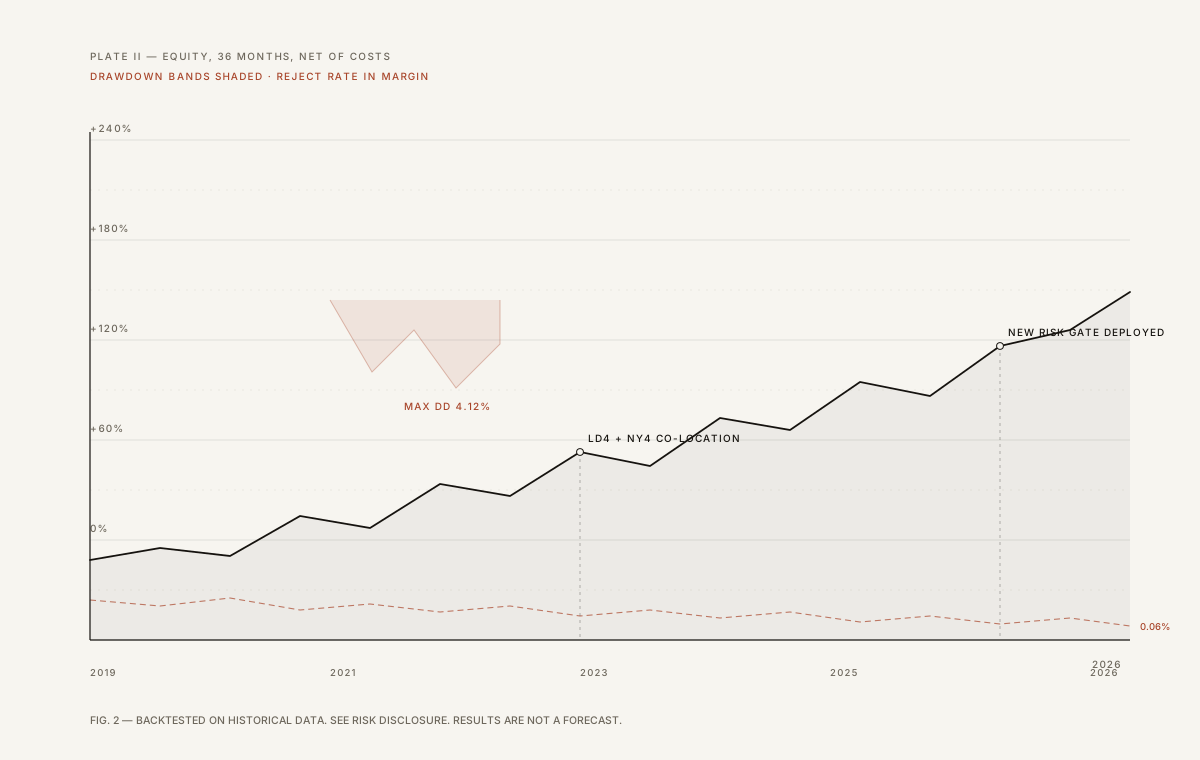
Fig. 2 Equity, 36 months net of costs. Drawdown bands shaded; reject rate in margin.
We publish performance only when it is reproducible: a named build, a named symbol, a named broker, a named date range. The chart above comes from a client deployment that has run continuously since 2019 — the two annotations mark the moments the system changed, not the moments the market did.
That distinction matters. A strategy that looks good only after a parameter change is usually a strategy that was fitted to the past. We are engineers, not forecasters; our job is to make the machinery honest, fast and observable, so that whatever the strategy does, you find out first.
Median RTT
4.8 ms — terminal to LP acknowledgement, LD4, EURUSD, 4.2 M orders
P99 RTT
11.7 ms — the number we actually design against
Reject rate
0.06% — down from 1.9% before the pre-trade gate
Reconciliation
Zero unexplained breaks across the last 26 months
02
What clients ask us for
Selected engagements
Client type
Brief
Delivered
Duration
CFD broker, 40k accounts
Replace a bridge that dropped sessions every Sunday open
Active/active FIX gateway, pre-trade gate, reconciliation suite
14 weeks
Proprietary desk, 8 traders
Enforce a daily-loss rule that traders could not override
RiskGate toolkit + manager panel, audited by the desk's compliance
5 weeks
Systematic fund, $60M AUM
Port a Python research model into production MQL5
Deterministic EA, replay harness, parameter CI
9 weeks
White-label startup
Stand up MT5, CRM and payments from zero
Server topology, manager/CRM glue, PSP integration, monitoring
11 weeks
“They sent a latency histogram before they sent an invoice. That is the entire reason we signed.”
Enquiries
Write to us with your terminal build, broker and a paragraph on what you are trying to ship. You will hear back from an engineer, not a form.
1. Which MT5 build and which broker server the system must run against.
2. What the strategy does when a fill is partial, late, or rejected.
3. What "done" means in numbers — RTT ceiling, reject rate, drawdown limit.
4. Who signs off, and who is on call at 03:00.
If you cannot answer the fourth question yet, that is fine. It is usually the one that decides the architecture.
We take on a maximum of six engagements a year. It is not a scarcity tactic; eleven people cannot do more without the quality slipping, and the quality is the only thing we sell.